

Traditional Arabic Scents Reimagined for Modern Homes
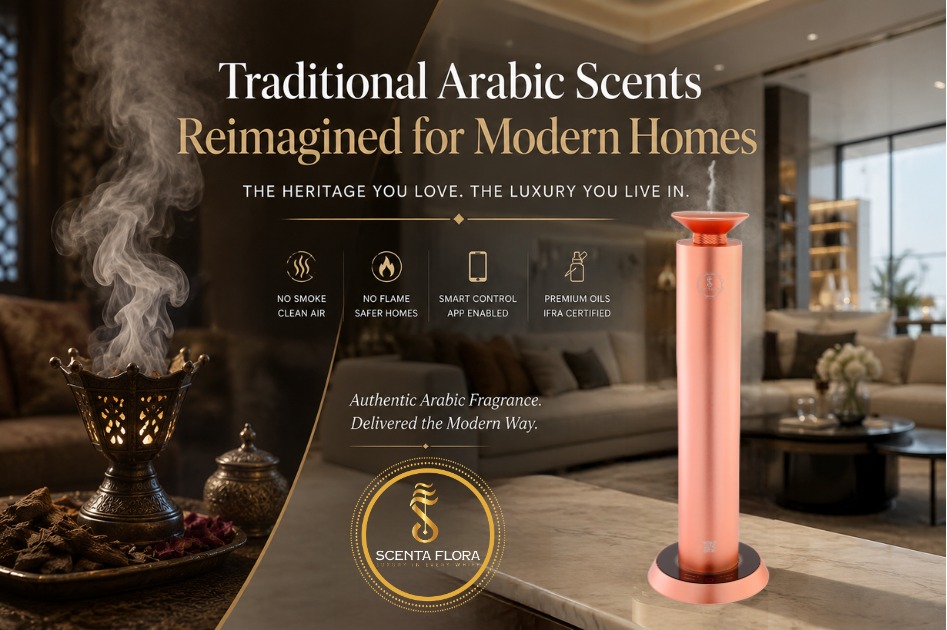
There is a reason certain homes stay in your memory long after you leave them.
Sometimes it is the architecture. Sometimes the lighting. But in many Arab homes, what people remember first is the scent.
Not perfume. Not air freshener.
The house itself.
The smell of oud moving quietly through the majlis before guests arrive. Rose lingering in corridors late at night. Amber caught softly in fabrics and upholstery. For generations across the Gulf, fragrance has never been treated as decoration. It has been part of hospitality, identity, and routine in a way many Western interiors still do not fully understand.
Traditionally, those scents came from bakhoor burned over charcoal.
And honestly, there is still something beautiful about that ritual.
The preparation feels intentional. Slow. Familiar. Even the smoke itself carries emotion for many people because it is tied to family gatherings, Eid mornings, weddings, prayer spaces, and childhood memories.
But rituals also evolve.
The reality is that modern homes function differently now than they did even twenty years ago. Villas today are more enclosed. Air conditioning runs constantly. Interiors are filled with delicate materials, automated systems, custom fabrics, and open architectural layouts that smoke was never designed for.
People still want the richness of traditional Arabic fragrance inside their homes.
They just no longer want the smoke, ash, maintenance, or heaviness that often comes with it.
That shift is quietly changing the luxury fragrance market across the UAE.
The Scent Stayed Traditional. The Delivery Changed.
One misconception about modern scent technology is that it somehow replaces traditional fragrance culture.
It does not.
If anything, it preserves it more naturally within modern living spaces.
Most luxury homeowners are not trying to move away from oud, musk, rose, saffron, or amber. Those fragrances still feel deeply connected to the emotional atmosphere of an Arab home. What people are moving away from is the inconvenience surrounding traditional scent diffusion methods.
Burning charcoal indoors every day no longer fits the rhythm of modern life for many families.
Not because the tradition lost meaning.
Because lifestyles changed.
People leave home earlier. Travel more. Entertain differently. Smart homes now control lighting, curtains, temperature, and security from a phone. Naturally, fragrance became part of that evolution too.
That is where brands like Scenta Flora entered the conversation in a meaningful way.
Instead of treating Arabic scents like old-world nostalgia, the approach became more thoughtful: preserve the character of traditional fragrance while modernizing how it moves through the home.
The result feels surprisingly seamless.
You still experience the warmth of oud or the softness of rose, but without smoke collecting in the air or charcoal burners sitting beside contemporary interiors that were clearly never designed around them.
Smoke Feels Different in Modern Homes
This is something people rarely talk about openly, even though many homeowners quietly notice it.
Traditional bakhoor behaves differently in today’s interiors.
Older homes were built with more natural airflow and different spatial layouts. Modern villas and apartments, especially luxury properties, are often tightly climate-controlled environments. Once smoke enters those spaces, it lingers longer than people expect.
Over time, it settles into curtains, textured walls, upholstery, and AC circulation systems.
Some homeowners love that lingering richness.
Others start feeling like the house never fully clears.
That conversation has become more noticeable recently as people pay closer attention to indoor wellness and air quality. Especially in homes where fragrance is used daily rather than occasionally.
Cold-air scent diffusion systems solve this very quietly.
- No flame.
- No smoke.
- No ash.
- No heated charcoal.
Just fragrance dispersed cleanly into the air in controlled amounts.
And interestingly, many people discover the scent itself actually feels more refined this way because there is no smoke competing with the fragrance profile.
- The oud smells smoother.
- The rose feels cleaner.
- The musk sits softer in the room.
You notice the composition more clearly.
Luxury Interiors Changed the Way Homes Are Scented
There is also a design reality that influenced this shift.
Traditional bakhoor rituals came from homes designed around tradition. Modern luxury interiors are designed very differently.
- Minimalist stone surfaces.
- Custom wood paneling.
- Italian fabrics.
- Integrated lighting.
- Open-plan architecture.
Everything feels intentional and visually restrained.
A charcoal burner sitting in the middle of that environment can sometimes feel disconnected from the space itself, especially in contemporary villas where the entire design language revolves around subtlety.
That is partly why hidden scenting systems became so desirable in luxury homes.
The best smart fragrance systems are almost invisible.
You do not really see them working. The scent simply exists naturally in the background of the space. Guests notice the atmosphere immediately, but there is no visible source competing with the interior design.
That subtlety feels more aligned with modern luxury.
Today, people are less interested in obvious displays of luxury and more interested in environments that feel effortless.
Scent plays a huge role in that.
Fragrance Is Becoming Part of Smart Living
There is another reason app-controlled scenting grew so quickly in the Gulf.
Convenience changed expectations.
Once homeowners became used to controlling lighting and climate through automation, manual fragrance rituals started feeling inconsistent by comparison.
With smart scent systems, fragrance becomes programmable.
A softer floral profile during the morning.
Low-intensity musk throughout the afternoon.
Deeper oud notes in the evening before guests arrive.
Everything adjusts automatically.
That level of precision changes the relationship people have with scent inside the home. Instead of occasional fragrance moments, the atmosphere remains consistent throughout the day.
And consistency is actually what makes a luxury environment feel luxurious.
Not intensity.
The best hotels in the world understand this very well. Their spaces never smell overpowering. The fragrance simply feels woven into the identity of the property itself.
More homeowners now want that same experience privately.
Modern Fragrance Consumers Ask Better Questions
Another noticeable change is that people have become far more informed about fragrance quality itself.
A few years ago, most buyers only cared whether something smelled strong.
Now they ask:
- What ingredients are being used?
- Is the oil safe for continuous indoor diffusion?
- Will it work properly with HVAC scent systems?
- Is the formulation certified?
That shift pushed premium fragrance brands toward greater transparency.
At Scenta Flora, IFRA-approved blends and certified formulations are part of the process because modern customers expect more clarity around what enters their homes.
Especially in luxury spaces where scent runs continuously throughout the day.
People want sophistication, but they also want reassurance that the products surrounding their families and interiors are properly formulated for long-term indoor use.
That combination of heritage, technology, and formulation quality is where modern Arabic home fragrance is heading.
Tradition Was Never Meant to Stay Frozen
Cultures evolve.
Homes evolve.
Luxury evolves too.
But some things remain emotionally permanent no matter how modern life becomes.
In the Gulf, fragrance is one of those things.
- Oud will still feel like hospitality.
- Rose will still feel comforting.
- Amber will still carry warmth into a room.
The difference is that today’s homeowners want those experiences delivered in ways that fit how modern homes actually function.
Cleaner. Safer. Smarter. More seamless.
Not less traditional.
Just more refined.